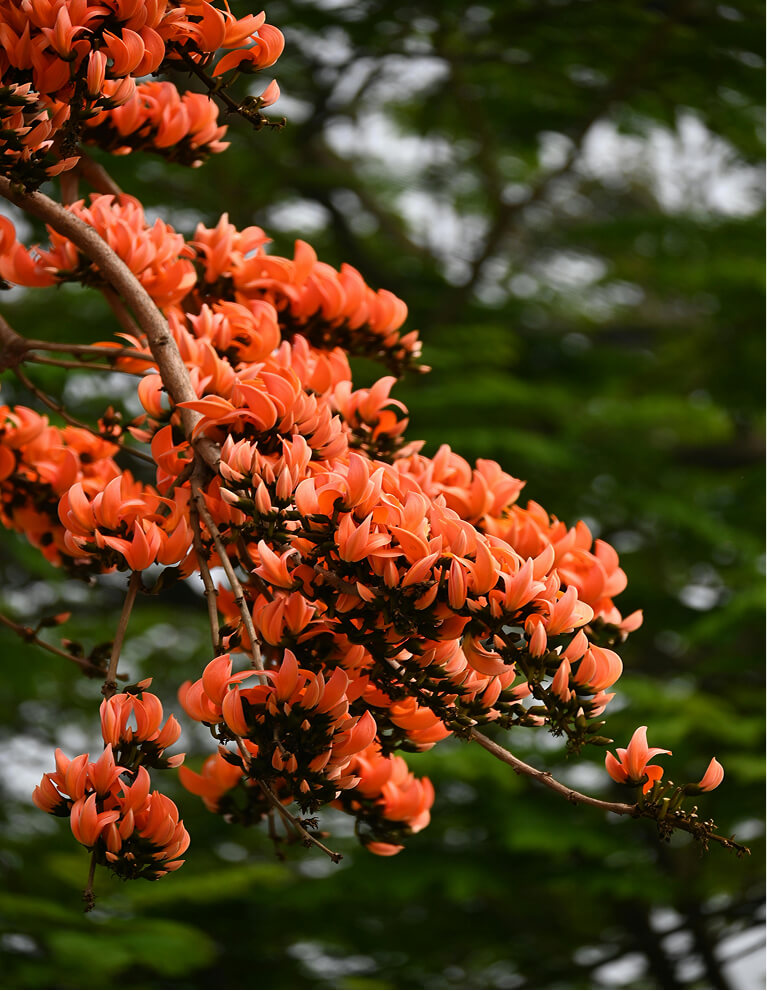
| Scientific Name | Butea monosperma |
|
|---|---|---|
| Common Name (English) | Bengal kino tree | Flame of the forest | |
| Common Name (Hindi) | पलाश (Puh-la-ash) | |
| Kannada Name | ಮುತ್ತುಗ (Muth-oo-ga) |
Plant card  |
This tree is medium-sized, slow-growing and deciduous. Characterised by tri-leaved foliage, when shed it flaunts bright orange flowers resembling a 'fire' in the forest. The colour of its flowers makes it a great focal element in gardens and can be planted individually or in clusters.
Introduction IntroductionPlant Identification

Leaf Type
Leaves are compound and obovate in shape with velvety texture and 6-8 cm wide and 10-20 cm in length.
Leaf Type 2
Leaves are compound and obovate in shape with velvety texture and 6-8 cm wide and 10-20 cm in length.
Leaf Type 3
Leaves are compound and obovate in shape with velvety texture and 6-8 cm wide and 10-20 cm in length.
Leaf Type 4
Leaves are compound and obovate in shape with velvety texture and 6-8 cm wide and 10-20 cm in length.
Leaf Type 5
Leaves are compound and obovate in shape with velvety texture and 6-8 cm wide and 10-20 cm in length.
Leaf Type 6
Leaves are compound and obovate in shape with velvety texture and 6-8 cm wide and 10-20 cm in length.
Leaf Type 7
Leaves are compound and obovate in shape with velvety texture and 6-8 cm wide and 10-20 cm in length.
Habitat & Distribution
The tree is found on plains and up to elevations of 1200m. Hardy, it is spotted in harsh climatic and geological conditions like rocky crevices, gravelly soils, and degraded landscapes of deciduous forests. It is found along roadsides, tank bunds and agricultural hedges.
Habitat & Distribution Habitat & DistributionEcological Services


Habitat provisioning
Its flowers and bark provide a multi-sanctuary habitat for small mammals and birds and many insects. The flowers - blooming in summers provide precious nectar and a refuge for squirrels and purple sunbirds. The Scabby bark and leaf litter create thermo-regulated habitats, making it a suitable habitat for snakes and lizards.
Leaf Type 2
Leaves are compound and obovate in shape with velvety texture and 6-8 cm wide and 10-20 cm in length.
Leaf Type 3
Leaves are compound and obovate in shape with velvety texture and 6-8 cm wide and 10-20 cm in length.
Leaf Type 4
Leaves are compound and obovate in shape with velvety texture and 6-8 cm wide and 10-20 cm in length.
Leaf Type 5
Leaves are compound and obovate in shape with velvety texture and 6-8 cm wide and 10-20 cm in length.
Leaf Type 6
Leaves are compound and obovate in shape with velvety texture and 6-8 cm wide and 10-20 cm in length.
Leaf Type 7
Leaves are compound and obovate in shape with velvety texture and 6-8 cm wide and 10-20 cm in length.
Provisional Services

Medicinal
Various parts of the tree, including bark, gum, leaves, flowers, and seeds are used to treat gastrointestinal disorders, infections, skin diseases, and parasitic conditions.
Leaf Type 2
Leaves are compound and obovate in shape with velvety texture and 6-8 cm wide and 10-20 cm in length.
Leaf Type 3
Leaves are compound and obovate in shape with velvety texture and 6-8 cm wide and 10-20 cm in length.
Leaf Type 4
Leaves are compound and obovate in shape with velvety texture and 6-8 cm wide and 10-20 cm in length.
Leaf Type 5
Leaves are compound and obovate in shape with velvety texture and 6-8 cm wide and 10-20 cm in length.
Leaf Type 6
Leaves are compound and obovate in shape with velvety texture and 6-8 cm wide and 10-20 cm in length.
Leaf Type 7
Leaves are compound and obovate in shape with velvety texture and 6-8 cm wide and 10-20 cm in length.